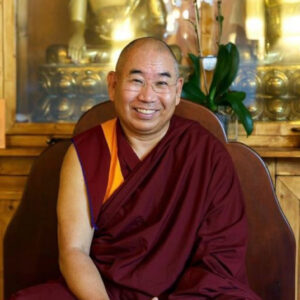
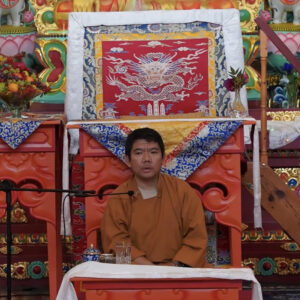
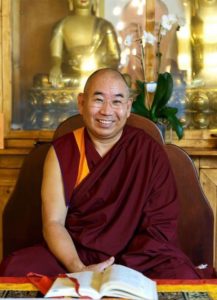
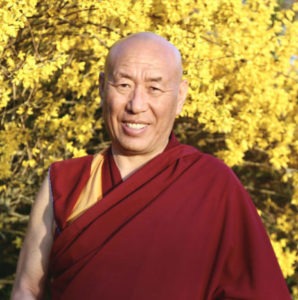
Geshe Lobsang Jamphel

Saturday 1 December 2007

Interview with Geshe Lobsang Jamphal - Abbot of Nalanda

"I was born on the 1st of February 1961 in Tibet. The village where my family lives is in the Lhoka area, about an hours drive south from Lhasa on the Lhasa-Tsetang road.

My parents were simple peasant farmers working in the fields to provide for us. For eight years I attended the local Tibetan school until I was fourteen. For the next five years I worked doing road construction and work in the fields. It was hard, physical labour. Up to then I’d never seen a single ordained person, monk or a nun. They simply seemed nonexistent those days in central Tibet.

However, from a young age I had heard a lot about Sangha, monasteries, and the practice of Buddhism from the elders in our village and surroundings. Those stories moved my mind to a great extent and eventually generated strong desire to follow the Buddhist path.

After the death of Mao Tse Tung in 1976 the Chinese grip over religious freedom in Tibet gradually loosened. I secretly took Getsul [Novice Ordination] and, in 1981, Gelong [full ordination] at Ganden Monastery near Lhasa. Our group of Tibetans was the first to take monastic vows in U-Tsang (Central Tibet) since the Chinese takeover in 1959.

I still remember how on our first trip to Lhasa crowds of people approached us on Barkhor for chagwang (blessing by placing hands on one’s head) just by the merit of us wearing monastic robes - an unthinkable scene in Lhasa for many years.

In the early 1980’s the door opened for exiled Tibetans and those within occupied Tibet to travel, to go on pilgrimage, and to see their relatives. The influx of people from the outside world brought information, whispered rumors, stories of India, and the realities of life in exile. What returned to the outside world were the eyewitness stories and first hand experiences of the sad state of affairs in Tibet.

Those stories about India influenced me a lot. I heard of the three great monasteries being re-established in exile, of the traditional curriculum of studies being taught there, and of people being able to learn, debate and practice openly without fear of reprisal. In fact it was just the opposite; they were being encouraged to do so by the government and the community.

Realizing how limited my ability was to learn Dharma in Tibet, the desire arose in me to leave my homeland and pursue Buddhist studies in India. Most of all I was motivated by the great wish to meet His Holiness the Dalai Lama, whom every Tibetan considers his or her spiritual leader.

So at age 22, in 1982, I embarked on the arduous, two-month journey across the Himalayas to reach the Nepal border and become a refugee. From Nepal we were transferred to the Dharamsala Reception Center for newly arrived refugees. It was there that we had the audience with His Holiness.

I have to mention here that I arrived to India with five other monks from Tibet. Our initial plan that all six of us would go together to Ganden Monastery changed after His Holiness advised us to follow our own inclinations.

I ended up going to Sera monastery with one of my friends. That same year I entered the Tse Thang Khang Tshen of Sera Je Monastery in the South Indian state of Karnataka. The first six years there were the most difficult years in my life.

Although I always had great enthusiasm and determination to continue with my studies, my physical condition was so poor that by the end of this time I was not even sure whether I could keep doing it or not. The change from the cool climate of the Tibetan plateau to the heat of subtropical India took its toll.

Also my financial situation was not good. Only after seven years in Sera did one kind English person offer to sponsor my studies by sending me the equivalent of 10 pounds a month. Later, a German person took over my sponsorship. After that my situation improved dramatically. My material worries went away and I was able to devote all my effort to my studies. I am very grateful to these people whose support played such a crucial role in my studies all the way up to the Geshe examination.

We studied in depth the great texts of the Geshe program. All this time I studied very hard and devoted all my free time to debates and self-study. The result was (as the common joke goes) that after spending almost twenty years in India I didn’t know a single word of Hindi.

In 1998, I successfully passed the Dratsang (Sera-je) Geshe examination and, in 1999, the Monlam examination resulting in the Lharampa Geshe degree. The Monlam debate is the philosophical debate/examination with the assembly of all the monks of the three great monasteries of Sera, Drepung, and Ganden around Losar (Tibetan New Year).

I continued my studies for one more year at Gyuto tantric college. I finished those in the year 2000. I consulted Drak Ri Dorje Chang Rinpoche of Sera Je concerning my future plans. His guidance has been crucial for all major steps in my life and he advised me to work as a resident teacher for the The Foundation for the Preservation of the Mahayana Tradition (FPMT).

Lama Zopa Rinpoche considered my options and the mo [divination] indicated that going to teach in Nalanda monastery would be the best thing to benefit western Dharma students. I arrived at Nalanda monastery on 11 January 2000.

This will not be saying something new but, when I arrived in the West for the first time, I was astonished by the extent of the material progress, welfare, prosperity, freedom, and social development these countries have achieved. But on the other hand, I was surprised by the level of anxiety, worry and unhappiness in the eyes of the people living here. The imbalance between external well-being and internal unhappiness really struck me.

In order to provide for themselves and their families and afford a particular lifestyle, people have to work really hard in the West. The more people have and the more they enjoy it, the more it seems they depend on it and eventually this dependency locks them into this vicious cycle.

It may sound a bit subjective but I feel that regardless of the striking poverty and all the external problems they face, people do look happier in India or even in Tibet. On the most superficial level, this Western dilemma of having fewer material and external problems but having more inner anxiety, dissatisfaction and mental unhappiness seems very obvious to me.

The stream of visitors seeking advice and guidance in their lives, together with the type of problems and disturbances they are facing shows that clearly.

Another new feature for me was the over excitement of many Buddhist students in the West about Tantric teachings and Initiations at the expense of more basic teachings. It looks as if they’ve already learned everything but this is not often the case. This attitude seems to me erroneous and rather unbalanced.

This is not to diminish the importance of the Vajrayana path. But it is said that the Sutra teachings are to be learned, contemplated and mediated upon beforehand. Topics like Lam Rim [Graduated Path], Boddhisattvacharyavatara [Engaging in the Bodhisattva’s Deeds], Lo Jong [Mind Training] and so forth are to be established first.

Without this firm basis of learning and understanding I see it as being rather foolish if not presumptuous to expect any realizations and attainments in one’s Tantric practice.

To paraphrase one common Tibetan saying: The deliciousness of the sweets is due to the kindness of the butter, while the Profound teachings of Tantra are due to the kindness of Sutra.

I really enjoy staying here at Nalanda Monastery. It is a very nice place with great potential. It has a core group of about ten Western monks who are dedicated and interested in studying Dharma in great depth. The discipline among the monks is excellent and the whole atmosphere of place is friendly, welcoming, and conducive to serious studies.

I see my main objective here as establishing a serious study program which is appropriate for monastic institutions.

I wish you all the best and that you have success in your Dharma practice. Please remember to study and take advantage of the teachings that are given. Also please make sure you apply these teachings to all the aspects of your life."


Home page | Contact | Site Map | Private area | Statistics | visits: 203622

Nalanda Monastery, Rouzegas, Labastide St. Georges, 81500 Labastide Saint Georges, France.


Tel: (+33) (5) 63-58-02-25


Creative Commons License